
Criminal Cases in the Wilson County Courts
Court level decides where a Wilson County criminal case file lives. The 81st and 218th Judicial District Courts hear felony matters, and the Wilson District Clerk keeps those files at 1105 Railroad Street in Floresville. Class A and Class B misdemeanors belong at the county level, with the County Clerk at 1420 Third Street, Suite 110 serving as the record custodian. A Class C appeal may also reach that office. Fine-only cases that have not been appealed remain with the issuing municipal court or one of the county's four justice courts.
The clerk records the prosecution after a complaint, information, or indictment is filed. That file can outlast a jail entry and can show how the charge changed. The official 81st and 218th Judicial District site identifies the courts that serve Wilson County and the other counties in the circuit.
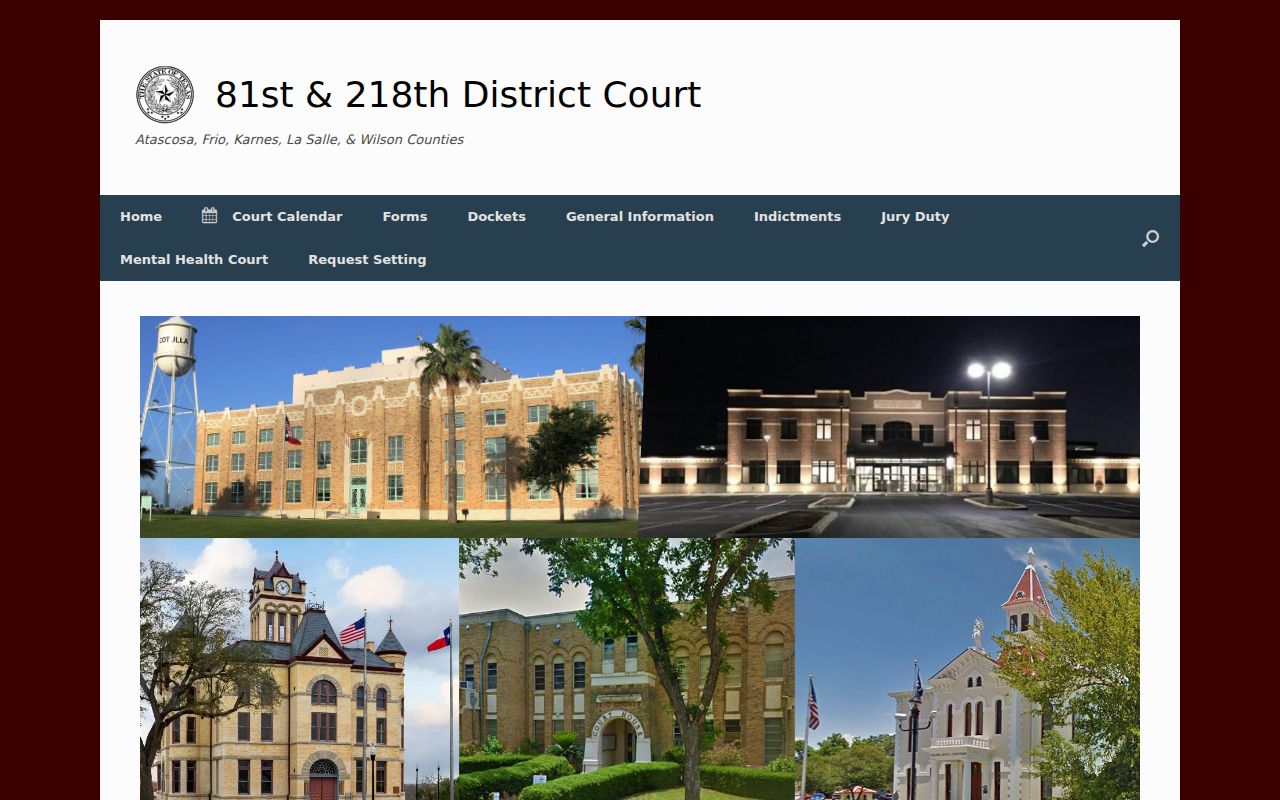
The district site helps identify the court and current schedule, while the Wilson clerk remains the filing counter for a Wilson case.
Wilson County Case Filing Boundary
A common search error is asking one clerk for every criminal matter. The County Clerk's online instructions draw a narrow boundary. Its name search covers Wilson County Class A and B misdemeanors and Class C cases only when appealed. It does not cover felonies, juvenile matters, federal cases, other counties, or ordinary justice and municipal dockets. Without a case number, the name search costs $5. Full name, date of birth, and any other sound identifier help the clerk separate people with similar names.
The official Wilson County Clerk criminal-record page states that scope and gives the copy rules.
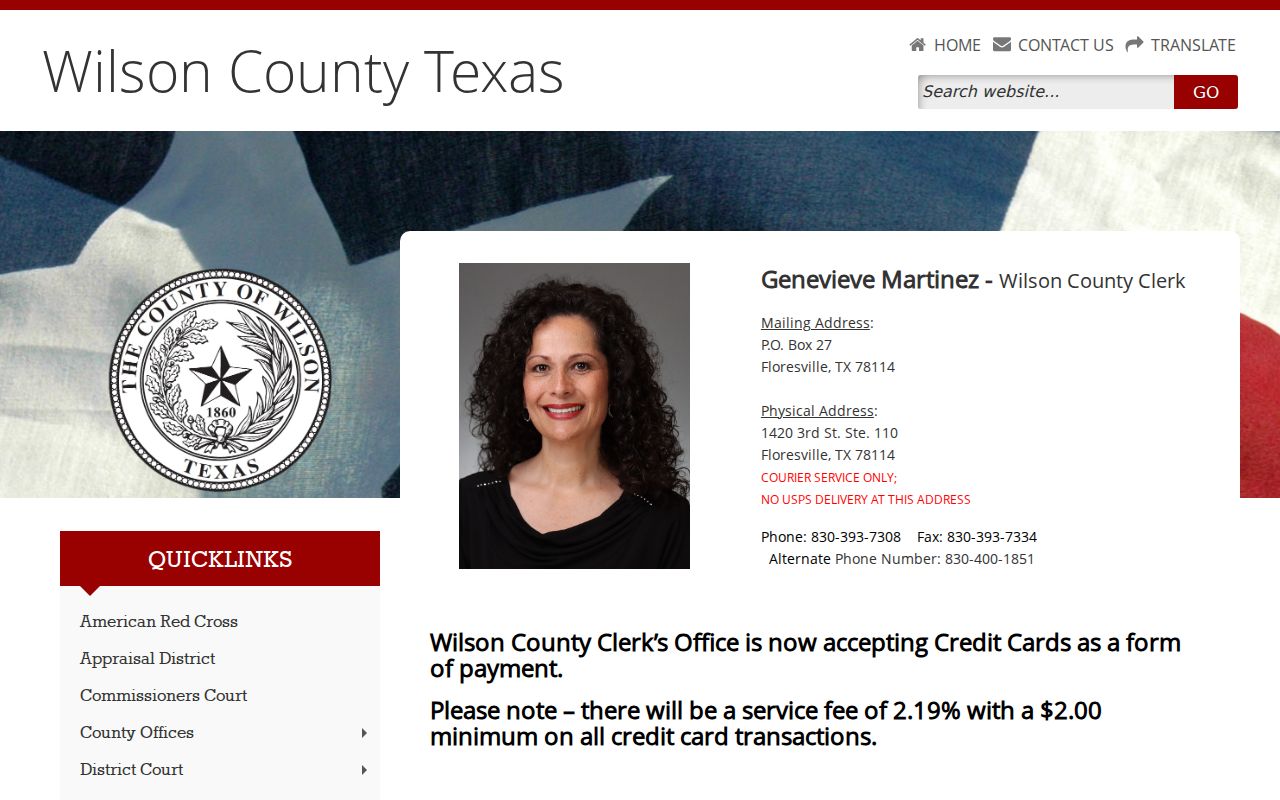
This boundary explains why a valid ticket or felony can be absent from the county misdemeanor search without the record being sealed or lost.
Copy type also matters. The County Clerk lists plain copies at $1 per page and certified copies at $1 per page plus a $5 certification charge. Criminal payments may be made by cash, cashier's check, money order, or credit card, but not personal check. Card use carries a 2.19 percent service charge with a $2 minimum. Those payment terms concern county-level criminal matters. A person seeking a district judgment should ask the District Clerk for its current copy and certification terms instead of applying the county clerk schedule to a felony file.
How to Search Case Records
Start with the court level, not a broad name query. Wilson County provides a District Clerk PUBLIC PORTAL for district records, local docket PDFs for settings, and a clerk-assisted misdemeanor search. The statewide re:SearchTX platform is another court-record route, although registration, document access, and coverage vary by court and user role.
- Decide whether the filed charge is a felony, a Class A or B misdemeanor, or a fine-only case.
- Use the District Clerk public portal for felonies, or submit the full name and date of birth to the County Clerk for its misdemeanor search.
- Check the WILS criminal docket when the goal is an upcoming district setting, but do not treat a calendar as the full file.
- Open the docket entries and compare case number, court, charge, filing date, and status before relying on a match.
- Ask the correct clerk for a plain or certified copy when the judgment, charging paper, or sentence must be confirmed.
The available channels accept these core identifiers. Not every field is required, and an exact case number is the best key.
| Field Label | Type | Required | Notes |
|---|---|---|---|
| Full name | Text | Yes for name search | Use the complete legal name |
| Date of birth | Date | Requested | Helps distinguish similar names |
| Case number | Text | No | Avoids the County Clerk's $5 name-search charge |
| Filing year | Date filter | No | Narrows a long result set |
| Court or case type | Filter | No | Separate district, county, and lower-court matters |
Wilson County Criminal Docket Codes
The traveling district courts publish weekly dockets for five counties. Wilson entries use the code WILS. The calendar then marks the type of setting: CR for criminal, GJ for grand jury, ARR for arraignment, JT for jury trial, NJ for non-jury, and JDC for jury docket call or pretrial. These short codes tell a reader why the case is set. They do not state the final outcome.
The official Wilson criminal docket list is useful when a portal result shows a case but not the next appearance.
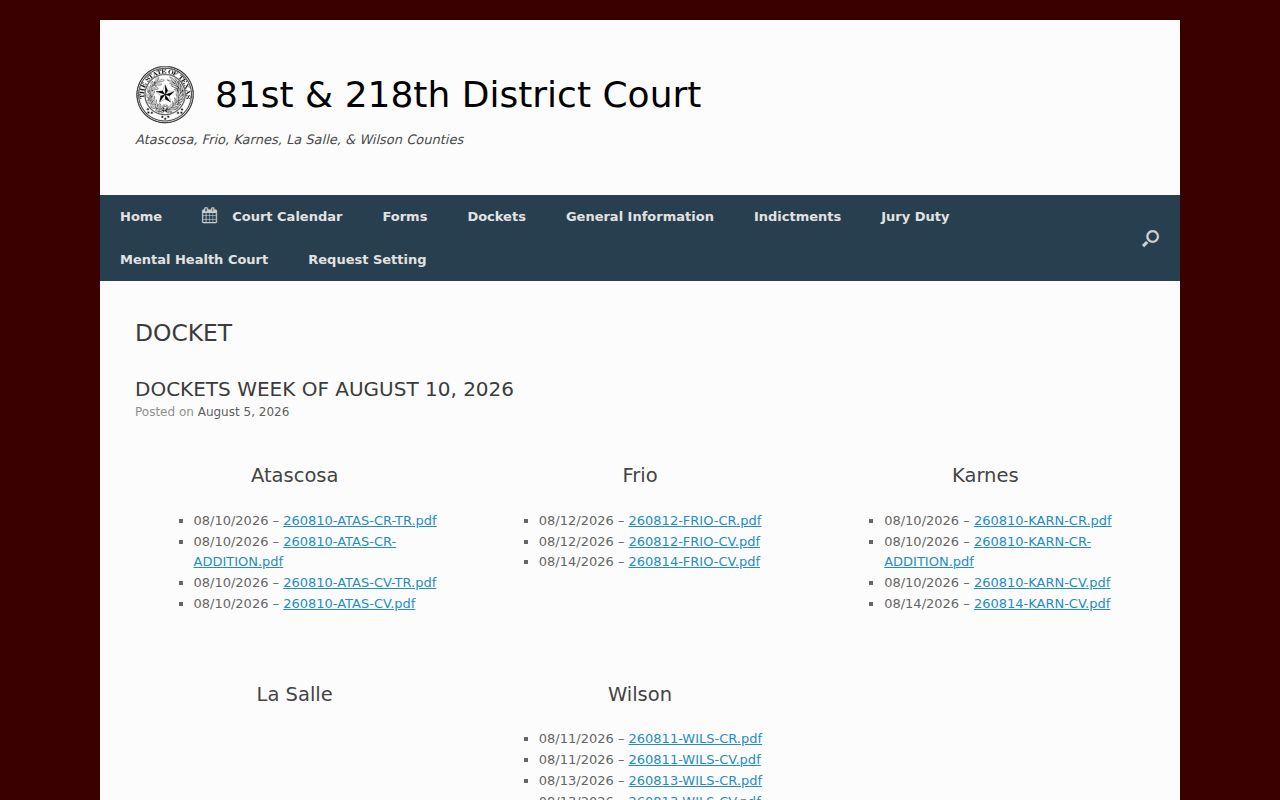
A WILS docket confirms a scheduled event. Obtain the filed order or judgment from the clerk before drawing a conclusion from that setting.
Note: A grand-jury setting is not an indictment, and an arraignment date is not a conviction or sentence.
What the Case File Shows
A Wilson County court file ties the accusation to what the court actually did. The public inventory can include a charging instrument, motions, orders, settings, a plea, disposition, judgment, sentence, and financial entries. Some fields can be redacted or withheld. The local portal was not used to capture a private person's record, so availability must be checked in the live file.
| Case Number & Court | Identifies the file, court level, and Wilson County venue. |
|---|---|
| Charging Document | Shows the complaint, information, or indictment and the filed charge. |
| Docket Entries | Lists filings, orders, settings, motions, and other recorded events. |
| Hearing Dates | Shows scheduled arraignment, pretrial, plea, or trial events. |
| Disposition & Judgment | States dismissal, acquittal, deferred adjudication, or conviction when entered. |
| Sentence & Conditions | May state confinement, community supervision, fines, costs, or restitution. |
For the charge at booking rather than the prosecutor's filed charge, consult the separate Wilson County arrest history channels.
Wilson County Felony Filing Counter
The 81st and 218th courts share a circuit administration, but Wilson County felony records do not move to the circuit office in another county. The local filing counter is the Wilson District Clerk at 1105 Railroad Street, Floresville, Texas 78114. Its phone is 830-393-7322. Hours are Monday through Thursday from 8:00 a.m. to 5:00 p.m., with a noon to 1:00 p.m. closure, and Friday from 8:00 a.m. to 4:00 p.m., subject to county holidays and posted closures.
The district court's official county-locations page confirms the Wilson address.
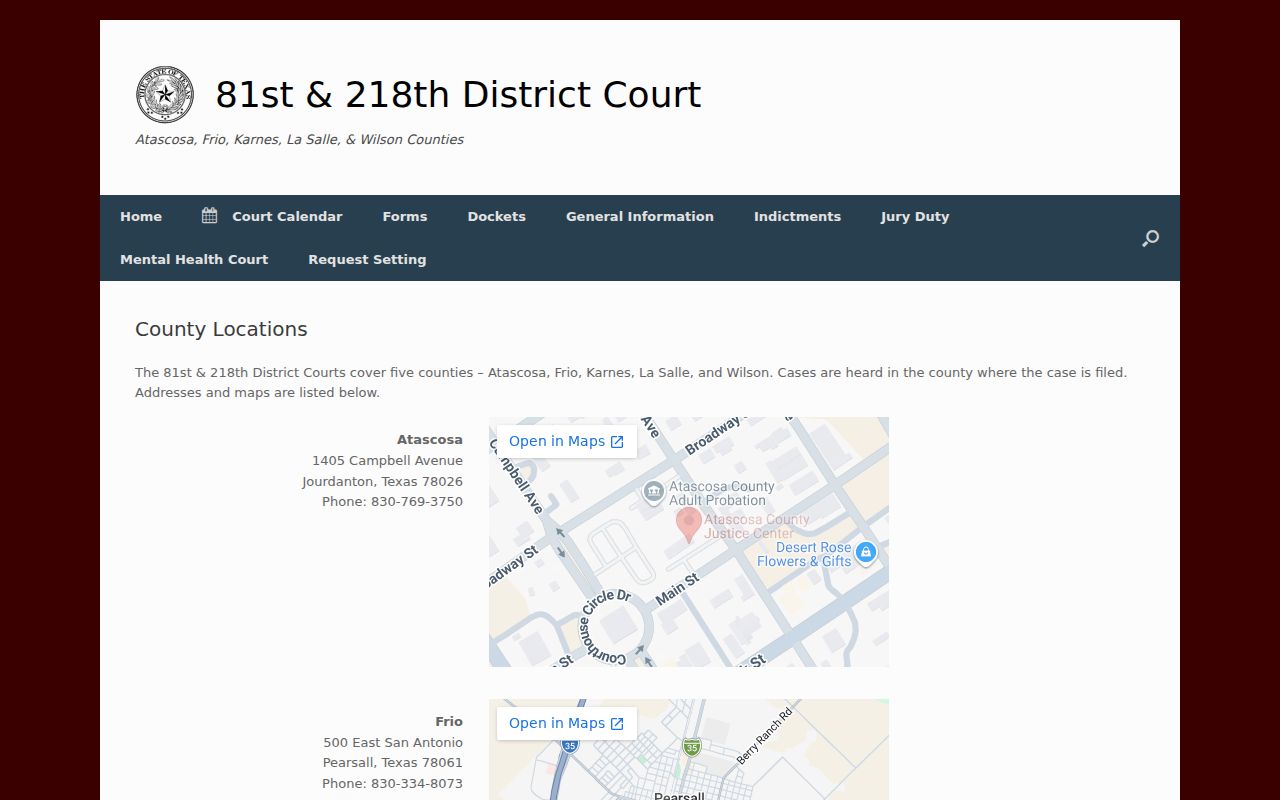
Calling the local clerk first can prevent a trip to a circuit contact that manages calendars but does not hold the Wilson file.
Stages of a Criminal Case
A Wilson County prosecution usually begins after arrest and magistration, when a judicial officer gives warnings and addresses probable cause and bond. Prosecutors then decide whether to proceed by complaint and information or seek a grand-jury indictment. The filed case advances through arraignment, pretrial work, and either a plea or trial. A judgment records the disposition. Sentencing follows a conviction or other adjudication that calls for it. An appeal, motion to revoke, or later order can add more docket events.
Case flow: Charges Filed › Arraignment › Pretrial › Plea or Trial › Disposition › Sentencing
Each step creates a different record. A setting shows what was planned; a signed order or judgment shows what occurred.
Wilson County Court Calendar Limits
The official district calendar places Wilson County in a five-county schedule with Atascosa, Frio, Karnes, and La Salle. It can help locate an arraignment, grand-jury date, jury call, or other setting. Yet a calendar is only a planning record. A case may be reset, disposed of, or continued after the PDF was posted. The clerk's docket and signed papers are the stronger sources for status and outcome.
The 81st and 218th court calendar shows the current code structure and setting pattern.
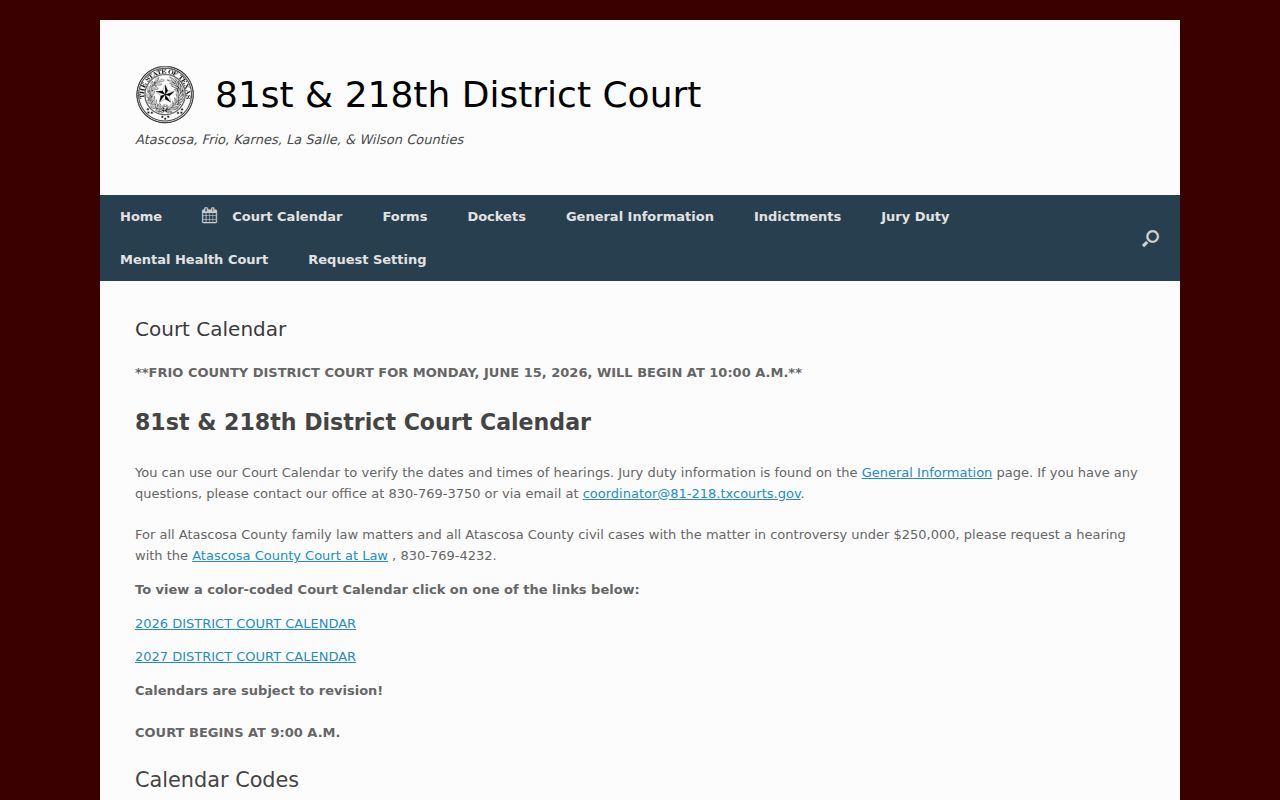
Use that visual schedule to find the event, then match the court and case number in the official Wilson County criminal case file.
Wilson County Case Outcome Terms
Disposition words matter because they answer different questions. A dismissal ends the charge without a conviction. An acquittal is a not-guilty result. A no-bill means the grand jury did not return an indictment. Deferred adjudication delays a finding while court-ordered supervision is completed, and Texas DPS can include it in the public conviction name search unless a nondisclosure order applies. A conviction is a judgment of guilt.
- Arraignment
- The formal stage at which the charge and plea are addressed.
- Disposition
- The result entered for the case or charge.
- Information
- A prosecutor-filed charging instrument commonly used for a misdemeanor.
- Indictment
- A grand-jury accusation used to proceed with a felony.
- Capias
- A court writ directing that a person be arrested.
The most reliable outcome is the signed judgment or order. A docket label may be brief, and a booking charge may differ from the filed offense.
Access & Restrictions
Texas court records are generally open, but public access has limits. Juvenile files, sealed documents, expunged records, victim and minor details, Social Security numbers, medical information, and other protected identifiers may be withheld or redacted. Online access can also be narrower than the paper file. The Texas Public Information Act governs many government records, while court access also follows judicial rules and sealing orders.
If a Wilson County case does not appear, confirm the spelling, date of birth, court level, and filing date. Then contact the proper clerk. District Clerk files cover felonies; County Clerk files cover its misdemeanor and appeal categories; municipal and justice courts keep matters within their own jurisdiction. A written request should ask for an existing record rather than demand new research or analysis.
Older and paper-only material may require clerk help even when newer docket entries appear online. Ask for the charging instrument and final signed order by name, case number, and court. That focused request is more useful than asking for a general criminal history, since each clerk can only produce records within its own custody.